
A mature palm can take decades to become part of a neighborhood and one day to disappear from it. The difference between a loss and a documented loss is what remains available after the crews leave.
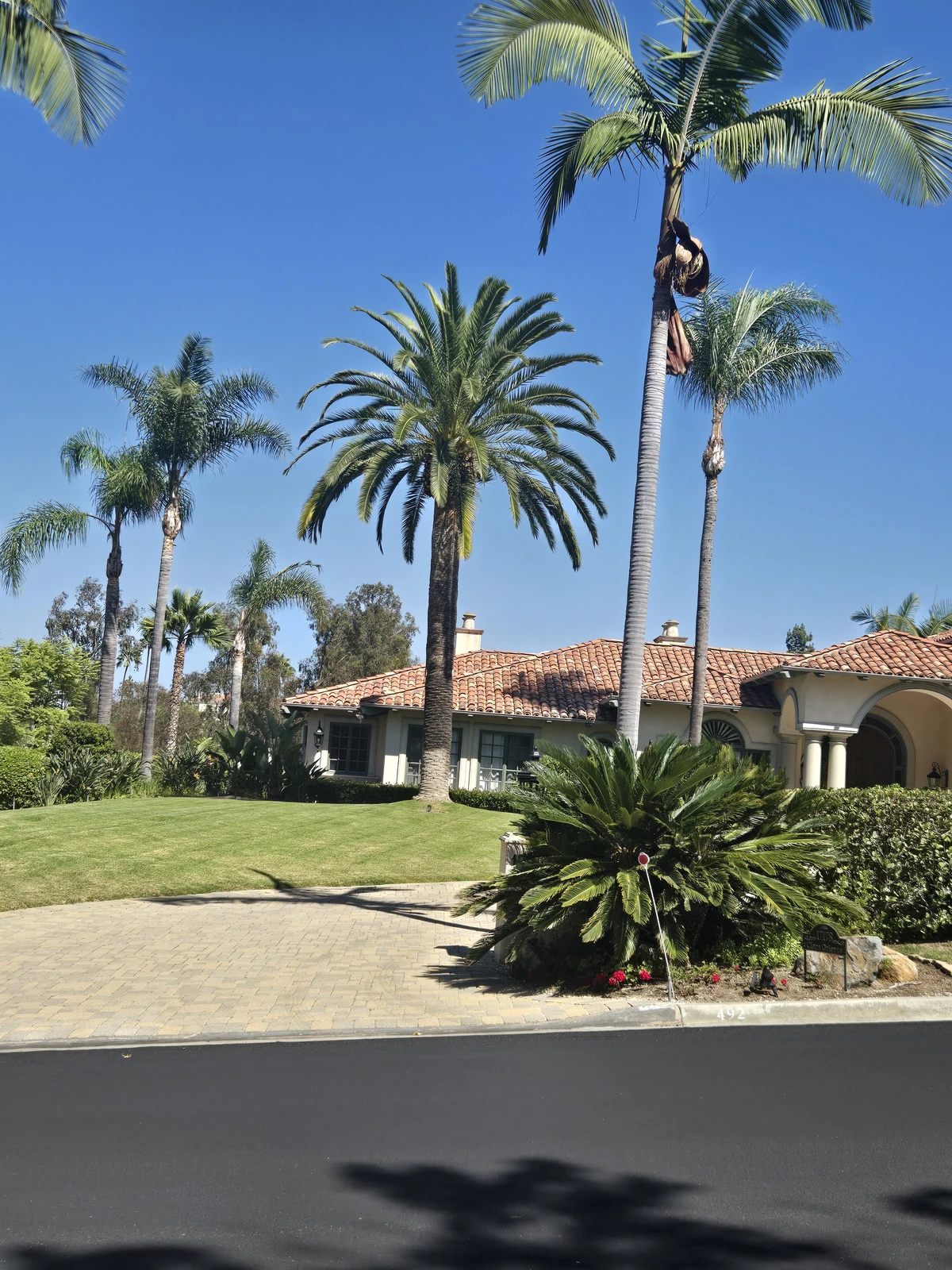
The landscape comes first
Before a palm becomes a condition note, a treatment entry, or a removal decision, it belongs to a place. It may frame a house, mark an entrance, rise above a block, or give an older property the scale that newer landscaping cannot imitate.
That wider view is not decorative. It explains the stakes. A tight crown photograph can show change, but it cannot show what the palm contributes to the property or what the landscape will lose if the tree is removed.
A palm needs an identity before it needs a story
A folder full of attractive photographs is not a palm record. The first job is simpler and more exact: establish which palm is which.
A stable identifier connects the palm to its location, dated whole-palm and crown views, visible-condition notes, known work history, and the next scheduled observation. Without that identity, photographs from the same property can be mistaken for one another. A healthy palm can become the “before” image for a different declining palm. The resulting story may look persuasive while being factually wrong.
What the evidence shows
Dated photographs, visible crown or trunk conditions, location context, and work that can be supported by records.
What the pattern may mean
A bounded professional interpretation that does not claim more certainty than the evidence supports.
What still requires an answer
Cause, concealed conditions, treatment history, dismantling findings, or other facts that the record does not establish.
Risk context is not a diagnosis
Adult South American palm weevils have been photographed in the record from my own Old Escondido property. That establishes local, owner-documented SAPW activity. It does not diagnose another palm across town—or another palm on the same block.
This boundary matters. Evidence becomes more useful when it is kept in the record where it belongs.
Then the record has to survive change
The real test comes when the palm no longer looks like the baseline—or no longer stands at all. The record should be able to connect the same subject or exact location across time without asking the reader to make a leap.
At Las Palmas, visible central-crown change was photographed before the palm was later documented as removed. The image below establishes the visible condition at that moment. It does not establish the underlying cause.
What remains after removal
A stump proves that a palm is gone. It does not preserve what the palm looked like, how the crown changed, what work was performed, who was contacted, or what was known when the next decision was made.
A disciplined record can preserve all of that without pretending to answer what remains unknown. It can also carry responsibility across changes in property staff, landscape crews, contractors, and ownership. The next person does not have to reconstruct the palm’s history from invoices, memory, and a camera roll full of unnamed trees.
Evidence boundary
- The Old Escondido landscape photographs and SAPW captures shown here come from an owner-approved, privacy-scanned website package.
- The Las Palmas image documents visible crown change before a confirmed removal; no public diagnosis is assigned.
- This is a limited field record, not a complete neighborhood inventory or a claim of municipal authority.
San Diego Palm Protection submitted mature-palm documentation for consideration during the City of Escondido Urban Forest Management Plan process. No City endorsement, partnership, or adoption is claimed.
The palm may be gone. Its identity, history, and unanswered questions do not have to disappear with it.